From AlUla, Saudi Arabia
The tomb nobody finished at Hegra
Qasr al-Farid stands alone at Hegra, and it was never completed. The rough lower part shows how the masons worked, and one unclear letter leaves two names for its owner.
By Anas Ismail
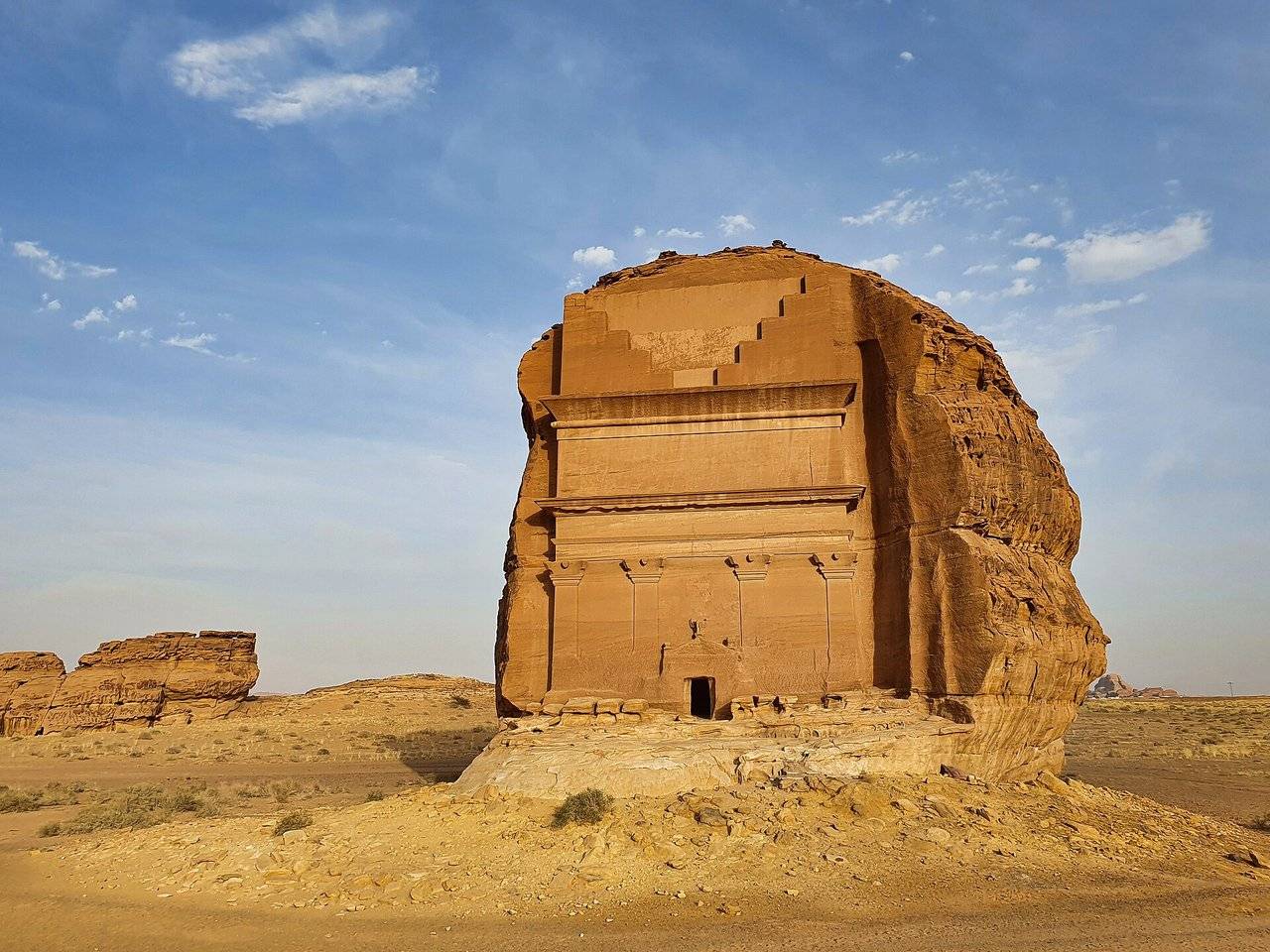
About two kilometres east of the southern entrance to Hegra, one rock stands apart on the plain. It is about 23 metres high and 18 metres wide, and the tomb façade cut into its front is almost as tall as the rock itself. People call it Qasr al-Farid, which is translated as “the Lonely Castle”. Despite the name, it is a tomb, and it was never finished.
From the top down
Hegra was a city of the Nabataeans, founded around the 2nd century BC. Archaeology magazine calls it the second-largest city of their kingdom, and it lay about 500 kilometres south of their capital, Petra. The Nabataeans grew rich on the caravans that carried incense and aromatics from South Arabia to the Mediterranean. UNESCO’s description puts Hegra on a trade route between the Arabian Peninsula, the Mediterranean world and Asia. The site has 111 monumental tombs, 94 of them decorated, cut between the 1st century BC and the 1st century AD.
The masons who cut these tombs started at the top of the rock and worked down. Qasr al-Farid is the evidence, because here they stopped partway. The top of the façade is complete. Lower down, the four pilasters have no finished bases or shafts, the decoration around the doorway is incomplete, and the lower third is still covered in chisel marks. The Royal Commission for AlUla estimates that about a third of the tomb was still to be carved, judging by how deep the entrance had been cut.
The doorway is about four metres above the ground. Above it, the winged figure at the centre, which the Hegra Conservation Project describes as a sphinx, is carved in detail, while the ornaments on either side are barely sketched. The project lists the tools whose marks remain: axe, pick, point chisel and flat chisel.
Four pilasters
The Royal Commission’s page calls Qasr al-Farid the largest of all the tombs at Hegra. It is also the only one with four pilasters across the front. The others usually have two. Archaeology magazine reads this as a sign that the frontier did things differently from the capital.
The Hegra Conservation Project dates the tomb to roughly the first three decades of the 1st century AD. Archaeology magazine says only that it was cut some time in the 1st century AD.
One letter, two names
Above the door is an inscription of a single line. It carries no date, and it does not follow the formula of the other legal inscriptions at the site. One of its characters can be read in two ways. The scholar J.F. Healey, who published the tomb inscriptions of Hegra in 1993, gives both readings. One is “For Hayyan son of Kuza (and) his descendants”. The other is “Lihyan son of Kuza took possession of it”.
The tomb is usually called the Tomb of Lihyan son of Kuza, which follows the second reading. The archaeologist Laïla Nehmé has suggested that the tomb changed hands before its first owner had time to inscribe his name. If she is right, the man who ordered this tomb left no name on it, and the man whose name is there may be Lihyan or Hayyan.
What is not known
I found no source that says why the work stopped. I also found none that says whether anyone was ever buried inside.
Hegra became Saudi Arabia’s first World Heritage property in 2008. Because the masons stopped when they did, the stages of their work can still be seen on the rock. The Hegra Conservation Project says the traces show best when the sun is low.
Anas Ismail
Planning a visit? Opening hours and how to get to Hegra, on Safrova Travel
Sources
- Hegra Conservation Project (Royal Commission for AlUla), “IGN110”. Accessed
- Hegra Conservation Project (Royal Commission for AlUla), “The Tomb of Lihyan, Son of Kuza”. Accessed
- Google Arts & Culture, Royal Commission for AlUla, “The iconic tomb of Qasr al-Farid”. Accessed
- Google Arts & Culture, Royal Commission for AlUla and UNESCO World Heritage, “Hegra: the Archaeological Site of Al-Hijr (Madâin Sâlih)”. Accessed
- Archaeology magazine, Eric A. Powell, “Petra’s Sister City”, July/August 2010.
- Arabian Rock Art Heritage (Layan Cultural Foundation), “Mada’in Saleh”. Accessed
- World History Encyclopedia, Carole Raddato, “Tomb of the Lion of Kuza, Hegra”.
- Livius.org, Jona Lendering, “Incense Route”.
- Wikimedia Commons, “Qasr al-Farid, Hegra (Madain Salih), 1st cent. CE, Saudi Arabia (20)”, photo by Richard Mortel. Accessed
