From Jeddah, Saudi Arabia
Jeddah’s house with the tree
By several accounts, old Jeddah had only one tree until the 1920s, a neem in front of Bayt Nassif. The house took its nickname from the tree, and in 1925 King Abdulaziz moved in.
By Anas Ismail
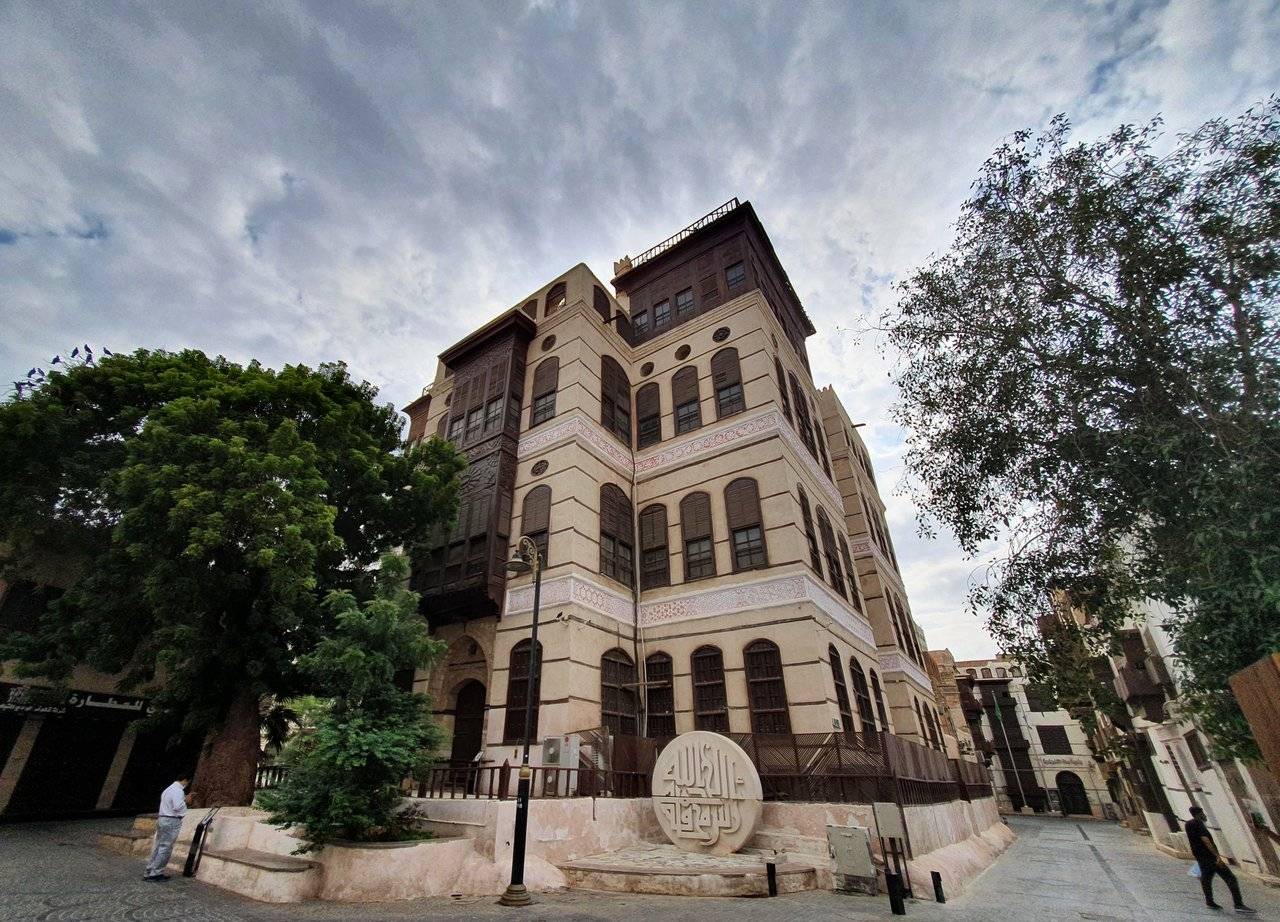
In the old town of Jeddah there is a tall house of coral stone, and in the small square in front of it stands a neem tree. The house is Bayt Nassif. For a long time people called it “the house with the tree”. By several accounts this neem was the only tree in Jeddah until the 1920s, so the nickname was enough to identify the house.
One tree
Encyclopaedia Britannica says the neem is likely native to the Indian subcontinent. It is called neem in Hindi and aryaveppu in Malayalam. Water was scarce in old Jeddah, so growing any tree there was hard. I found no source that says who planted this one, or where the sapling came from. Even the claim that it was the city’s only tree is not made with the same confidence everywhere. Archnet, an architecture archive, says it was the only tree in Jeddah until the 1920s. Arab News says only that it was once believed to be.
The merchant’s house
The Suez Canal opened in 1869, and steamships began to link Europe with India and the rest of Asia. UNESCO says Jeddah saw the last boom of Indian Ocean trade in those years. In the late 19th century the city’s rich merchants built tall houses decorated with large wooden window screens called roshan. Jeddah was also the port where pilgrims coming by sea landed on their way to Makkah, and pilgrims from India had been landing there since at least the 14th century. Rooms in the tall houses were rented to them.
Sheikh Omar Effendi Nassif built his house around that time. He was a notable of Jeddah and came from one of its powerful trading families. The sources disagree about the date. Archnet says the house was built between 1872 and 1881. Saudipedia gives 1872 and says the work took four years. A Google Arts & Culture page about the house, part of a project made with the Saudi Ministry of Culture, gives 1865.
The walls are coral limestone taken from the shore of the Red Sea, covered with white plaster to protect the stone from the damp air. Above the main door is a bay window carved from Java teak, two floors high. Under the ground floor are two cisterns for rainwater.
On 15 December 1880 a traveller, Lady Anne Blunt, wrote in her journal that she had called on Omar Nassif that afternoon. She also noted a chestnut mare standing outside the small yard by the house. The part of the journal that has been quoted mentions the horse but no tree.
Stairs for four legs
The house has four floors, and the kitchen is on the fourth. Its staircase mixes steps with ramps. Archnet says this made it easier to reach the upper floors on a riding animal. Arab News says the ramps let camels walk up to the upper terrace. The Lonely Planet guide says King Abdulaziz installed the ramps so that his messengers could ride their camels to the top. The accounts agree that there are ramps and that whatever climbed them had four legs. Two of them name the camel, and only one says who put the ramps in.
The king moves in
In December 1925 King Abdulaziz entered Jeddah. The people of the city and its leading merchants welcomed him at Bayt Nassif, and he made the house his residence. Saudipedia says he used it for about ten years. According to the same source, he heard citizens’ requests there, signed agreements with the ambassadors and delegates of several countries, and received guests of the state.
The books, and the tree again
The house also held a library of thousands of books. Archnet puts the number at 16,000. The books later went to King Abdulaziz University. In 1975 the Saudi government bought the house and made it a historic landmark. Today it is a cultural centre with exhibitions and lectures. Historic Jeddah has been on UNESCO’s World Heritage List since 2014.
The neem still stands in the square by the entrance.
Anas Ismail
Planning a visit? Opening hours and how to get to Historic Jeddah (Al-Balad), on Safrova Travel
Sources
- Archnet, “Nassif House Museum”. Accessed
- Saudipedia, “Nassif House”.
- Arab News, “ThePlace: Naseef House, residence for King Abdul Aziz in 1925”.
- UNESCO World Heritage Centre, “Historic Jeddah, the Gate to Makkah”. Accessed
- UNESCO World Heritage Centre, advisory body evaluation of “Historic Jeddah, the Gate to Makkah” (ICOMOS). Accessed
- UNESCO World Heritage Committee, Decision 38 COM 8B.21. Accessed
- Google Arts & Culture, Jeddah Historic District and Saudi Ministry of Culture, “Bayt Nassif: Connecting Historic Jeddah’s Past to the Present”. Accessed
- Encyclopaedia Britannica, “neem”. Accessed
- Lonely Planet, “Naseef House”. Accessed
- Edouard Aldahdah, Daughter of the Wind, “The Naseef House in Jeddah in Lady Anne’s Journals”.
- Wikipedia, “Nasseef House”, citing Susana Ibarra de Pint, Discovering Old Jeddah (2005). Accessed
- Wikimedia Commons, “Bayt Nasif, 1872, old Jeddah, Saudi Arabia (6)”, photo by Richard Mortel. Accessed
