From Riyadh, Saudi Arabia
Who threw the spear?
On a January morning in 1902 a spear ended up in the gate of Masmak Fort in Riyadh. The accounts still disagree about who threw it, and about whether its tip is still there.
By Anas Ismail
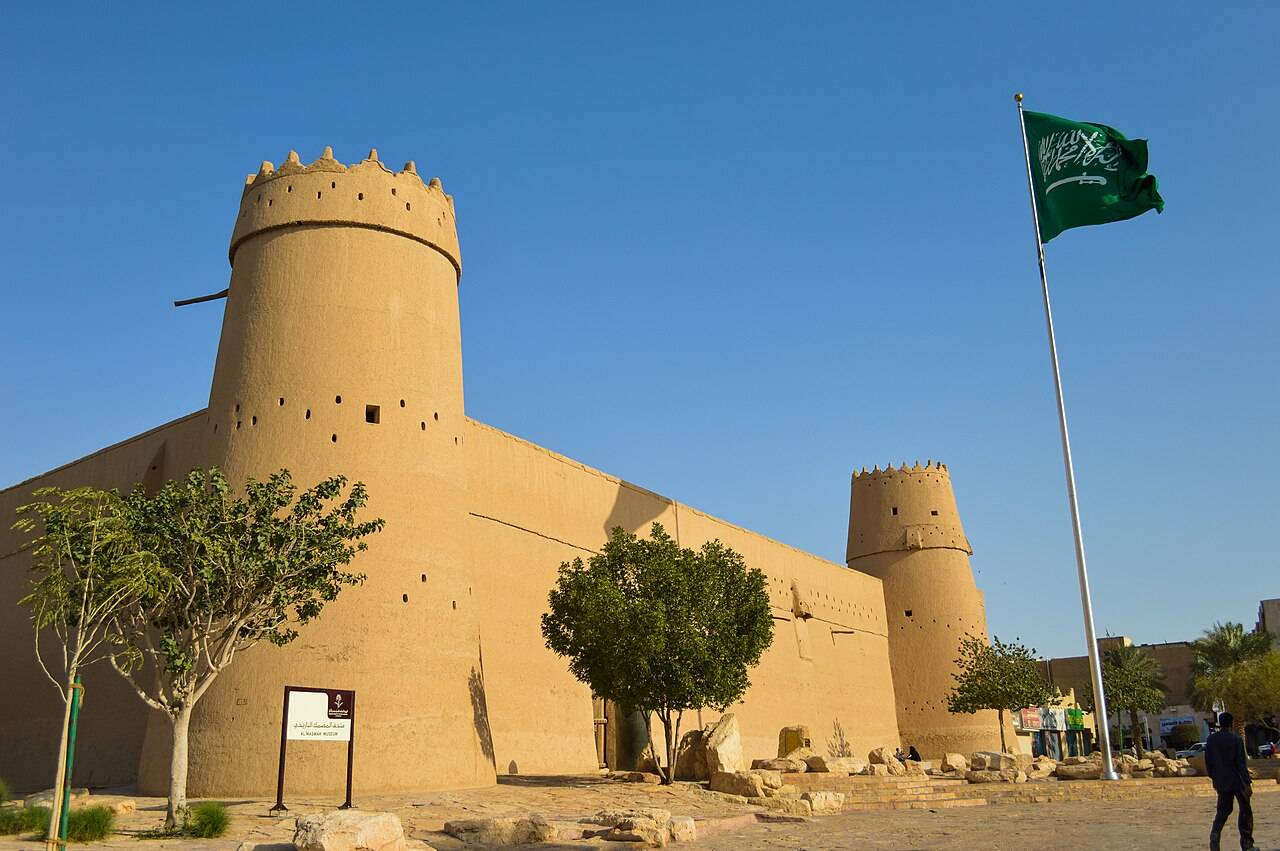
The gate of Masmak Fort is made of palm trunks and stands about 3.6 metres high. Set into it is a door so small that people have to bend and go in head first, one at a time. Visitors to the fort in central Riyadh stop at this door and lean close to the wood, because they have been told to look for the tip of a spear. It has been part of the story of this gate since the morning of 15 January 1902.
A family without a town
Masmak was built in 1865, in the time of Imam Abdullah bin Faisal, to defend Riyadh. It has thick mud-brick walls, four towers and one main way in. In 1891 the Al Saud family lost a battle at Mulayda and lost Riyadh with it. They went into exile and settled in Kuwait. After that a governor named Ajlan held the town for the Rashidi rulers of Hail, and Masmak was his fort.
Late in 1901 Abdulaziz, the son of Abdulrahman, rode out of Kuwait with a small band of relatives and volunteers to take his family’s town back.
Fifty days of waiting
On the way they lived on butter, dates and water carried in goatskins. Then, for almost 50 days, they stayed hidden near the oasis of Yabrin, on the edge of the Empty Quarter, until the garrison in Riyadh had stopped expecting them. Abdulaziz chose the end of Ramadan for the last ride, when the moon was thin and the nights were dark.
The night
A plaque at Masmak lists the 63 men who were with him. Most of them did not go over the wall that night. About a third stayed outside the town with the camels, with orders to ride back to Kuwait if they heard nothing within 24 hours. Abdulaziz’s brother Muhammad waited in the palm groves with 33 more. Only Abdulaziz and seven others went over the town wall.
The first house they entered belonged to a cattle dealer, who ran away. The women of the house recognised Abdulaziz, so they were shut in so that they could not raise the alarm. The next house was the governor’s own, and the raiders got into it by standing on one another’s shoulders. They found the servants and no governor. Ajlan, they learned, did not sleep at home. He slept inside the fort opposite and came out after sunrise.
So the men who had crossed a desert to take Riyadh sat in the governor’s house and waited for morning. Years later, as king, Abdulaziz told the story himself. By his account they slept a little and then said the dawn prayer.
Sunrise
At sunrise the gate opened and Ajlan walked out with about ten guards. Abdulaziz and his men ran at them from the house. The guards scattered, and Ajlan, sword in hand, turned back for the small door. Abdulaziz caught him there. For a moment the governor was stuck in the doorway of his own fort, with his men pulling him in from the inside and Abdulaziz holding on from the outside.
By most accounts, a spear was thrown at Ajlan there, missed him and went into the wood of the gate.
Ajlan got inside. Abdullah bin Jiluwi, a cousin of Abdulaziz, went in after him through the small door, and the governor was killed inside the fort. The gate was opened from within, the men from the palm groves ran up, and the garrison surrendered. Abdulaziz later summed up the fight in one line:
We were 40 and there before us were 80.
King Abdulaziz, as given in Aramco World, 1999
A man climbed to the top of the fort and called out to the town that Abdulaziz had returned and that Riyadh was now his.
About 30 years later, in 1932, the Kingdom of Saudi Arabia was proclaimed.
Whose spear?
The accounts agree that a spear went into the gate that morning. They disagree about who threw it and about what became of its tip.
- Aramco World, drawing on the king’s own account, said in 1999 that Abdullah bin Jiluwi threw it at Ajlan and missed. It said the steel point stayed in the wood until it was taken out in the 1970s.
- Arab News wrote in 2003 that Abdulaziz threw it himself, at the small door, as the defenders tried to shut it. It said the tip had snapped off and was still in the gate, a few centimetres from the small door, where it was easy to overlook.
- Arab News wrote in 2021 that Fahad bin Jiluwi threw it at Ajlan and missed, and that the tip was still there.
I cannot tell you which account is right. The fort went on to serve as a warehouse and a prison. It has been a museum since the 1990s, and it reopened in 2025 after restoration. Guides there still show visitors where to bend down beside the small door and look.
Anas Ismail
Planning a visit? Opening hours and how to get to Masmak Fort, on Safrova Travel
Sources
- Aramco World, “There Were 40 of Us…”, January/February 1999, adapted from Saudi Aramco and Its World (1995).
- Arab News, “At the Center of Saudi History”.
- Arab News, “Masmak Fortress: an important historical symbol of Saudi unification”.
- Arab News, “The story of all the king’s men”. Accessed
- Saudipedia, “Battle of Riyadh”. Accessed
- Gulf News, report on the reopening of Al Masmak Palace Museum after the 2025 restoration. Accessed
- Encyclopaedia Britannica, “Ibn Saud”. Accessed
- Wikimedia Commons, “Masmak Fort (12753717253).jpg”, photo by Francisco Anzola. Accessed
